

Mom Daughter Wedding Twinning: Dressing as the Guest Pair
For a wedding, mother daughter twinning should be subtle: share a colour or border rather than a full print, keep both outfits a clear step below bridal grandeur, and avoid the bridal party's colour if you know it. A silk saree beside a matching pattu pavadai is the classic done right.
Wedding twinning carries one rule that festival twinning doesn't: you are guests. The matched pair photo is wonderful; the matched pair upstaging the bride's little sister is a story your family will tell at your expense for years. Here's how to land on the right side of that line. For the one element rule and every other occasion, start with the twinning guide.
The wedding calibration
Think of twinning intensity as a dial. Festivals run it at full; weddings run it at one third:
| Match level | When to use it |
|---|---|
| Full fabric match | Save it for the reception, where dress codes relax, or skip it |
| Border and colour match | The wedding sweet spot, her saree's border echoed in the pavadai's hem |
| Colour echo only | Always safe, always elegant |
And the etiquette checks: avoid solid red if the bride's community dresses brides in red, sidestep the bridal party's announced colour, and at the muhurtham keep both outfits traditional rather than trend forward. None of this is restrictive in practice, it's three colours out of a hundred.
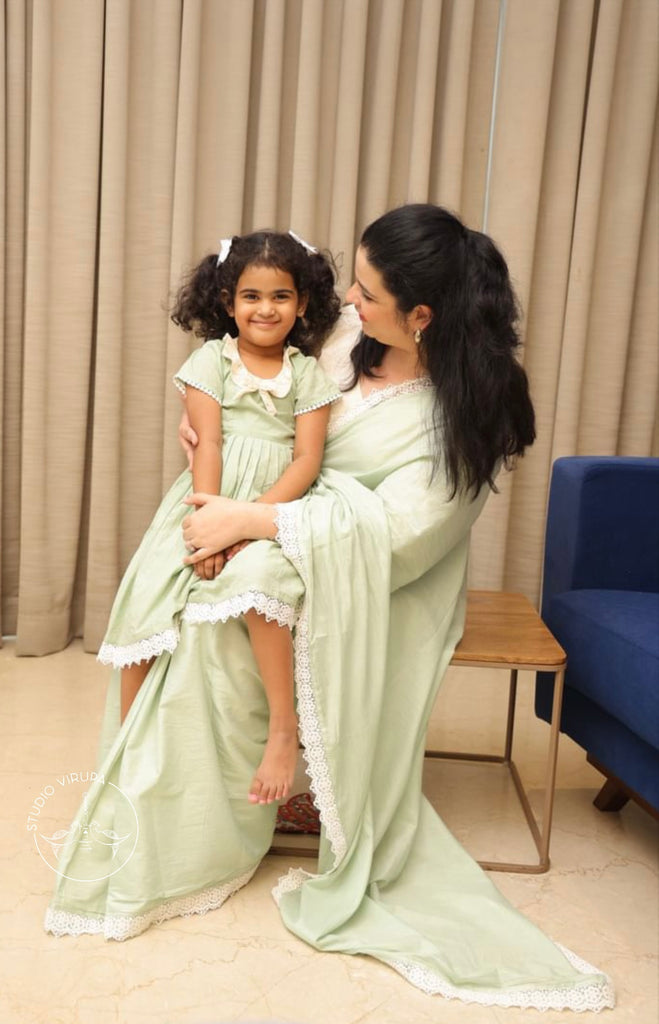
The looks that work
- The classic guest pair. Mom in a kanjivaram or soft silk in emerald, plum or royal blue; daughter in a pattu pavadai sharing the border colour. Traditional, photogenic, zero risk. This is the default for a reason.
- The morning ceremony pair. Lighter silks or fine cottons, the muhurtham is early and long. Mom in a warm cream and gold saree, daughter in cream and gold pavadai, reads beautifully against the mandapam and survives three hours of seated rituals.
- The reception pair. The evening allows shine: mom's brocade blouse or richer silk, the daughter's lehenga or silk pavadai with more sparkle. This is where the full fabric match, if you own one, gets its moment.
- The family of the couple pair. If you're the groom's sister or the bride's aunt, you're semi hosting: slightly richer fabrics are expected of you, and the twinning photo with your daughter becomes part of the official album. Plan it with the photographer rather than around them.
The long day logistics
A wedding asks more hours of an outfit than any festival. For the daughter's half of the pair: full lining, no exceptions, a pavadai waist that's elastic rather than drawstring, and a planned mid event change for under fives, the ceremony outfit and the simpler dinner outfit. Carry the spare; the spare is never wasted. The complete comfort spec lives in our kids' fabric guide.
For mom: blouse comfort decides the day. A beautiful saree with a tight blouse is a countdown timer. Stitch or buy with the long sit in mind, and if the wedding is out of town, pack the pair's outfits in one bag, separations happen to luggage, not to outfits.
A note from our team in Tirupur. The wedding grade version of the matched set, silk and silk touched cottons cut as pairs, is exactly what our mom daughter collection is for: same dye lot, both sizes, one order, made in Tirupur. A replacement piece from the same run still matches, which an assembled pair from two shops rarely does.
Shop the wedding grade pairs in our mom daughter collection. For the louder, freer version of twinning, festivals are the playground, read the festival edition.
FAQ
Can mother and daughter wear matching outfits to a wedding?
Yes, kept subtle: share a colour or border rather than identical fabric head to toe, and stay clearly below bridal grandeur. The classic is a silk saree beside a pattu pavadai in the same border colour.
What colours should we avoid at a wedding?
The bride's signature colour (often red), the bridal party's announced colour if you know it, and at South Indian morning ceremonies, black. Everything else is open.
What should a little girl wear to a South Indian wedding?
A pattu pavadai is the traditional answer, lined and elastic waisted for comfort. For evening receptions, a silk lehenga or richer pavadai works beautifully.
Should we match for the ceremony or the reception?
The reception is the easier stage for visible twinning, dress codes relax and photos are informal. At the ceremony, keep the match to a border or colour echo.